The Admiral’s Daughter: A Frontier Secret
Roughly a decade ago, I began a broader project to show how every American connects to both the most heroic and ordinary figures in our nation's history. For every Jimmy Carter or Bill Clinton, there is a brother like Billy or Roger. The profound and the profane—and usually a little bit of both—coexist within each of us.
The saying that history is written by the winners is often misunderstood. It's not that the actual victors write down history, it's more akin to everyone being the hero of their own life story. It’s the central irony of how the United Daughters of the Confederacy spun their revisionist history in the Lost Cause Myth. What I think is implied but unsaid, is that the truths are preserved in the silences of the less popular aspects of the archives. Which leads me to my own family mystery. For two and a half centuries, naval history has leaned on a genteel legend to explain why John Paul—a low-born Scottish captain fleeing from a murder beef—suddenly re-emerges in 1775 as the newly minted “John Paul Jones.”
Popular fiction attributes his “lost” years and sudden name change solely to a stay with inland North Carolina politician Willie Jones. However, historical records and DNA matches point to a much more complex truth. Instead of hiding inland, he spent those years navigating the coastal channels of North Carolina and collaborating with prominent Revolutionary figures in Virginia to prepare for war with the British. This hidden history also reveals a stunning secret: the existence of an unacknowledged daughter born to our nation's original, swashbuckling naval hero and Virginia blue blood Dorothea Spotswood Dandridge.
(There is a beautiful irony wrapped up in this lineage. While several Black ancestors from the other side of my family spent generations trying to pass as white on official censuses, the Dandridge name achieved its ultimate immortality through a Black icon—Dorothy Dandridge, the legendary star of Carmen Jones.)
Their daughter was named Ellen Jones (my dad’s great-great grandmother, 1776–1847) and she was born on the eve of the revolution. As you peel back the layers you find a scaffolding of protective legends managed by some of the architects of our Republic that provided a much less scandalous history for her. Even so, Ellen’s bloodline would go on to spawn some of the most privileged, creative, eccentric but also salt of the Earth folks on the American frontier—hidden in plain sight.
The Tinderbox: Hanover County, Virginia 1774–1775
In December 1773, after killing a mutinous crew member in Tobago, John Paul abandoned his ship and assumed the camouflage of a new name "John Jones." During these "lost years," he navigated two worlds: the unmonitored coastal channels of North Carolina and the elite planter society of Virginia.
In 1774, he was sheltered by Dr. John K. Read, a physician and nephew-in-law to Benjamin Franklin. Read’s estate bordered the plantation lands of Hanover County, the epicenter of Virginian aristocracy as well as both revolutionary and loyalist sentiment. Here, the rough-hewn Scottish captain crossed paths with Dorothea. She was the archetypal southern Belle: granddaughter of Royal Governor Alexander Spotswood and first cousin to Martha Dandridge Custis Washington. Dorthea’s mother died in late 1773 and at the same time her home was a frantic hub of pre-revolutionary activity. In 1774/75, 17-year-old Dorothea entered a clandestine romance with the fugitive captain.
The correspondence between Dr. Read and John Paul Jones in 1778 confirm the intensity of this affair, with Read noting that Dorothea’s father, Nathaniel West Dandridge, had "used every means in his power to prevent her from thinking of you."
The stakes were existential. By 1775, Dorothea’s cousin, George Washington, was Commander-in-Chief. An out-of-wedlock pregnancy between a high-society lady and a murderer would have caused a social disaster to the Dandridges and would have been a propaganda win for the Redcoats. When Ellen was born in 1776, she was scrubbed from public registries. The baby had to vanish because what would the neighbors or new country think? The keepers of this fiction were well known in their own right: Patrick Henry, Thomas Jefferson, and Joseph Hewes.
Upon further digging, I found out that to fix the problem, a scheme was hatched. In 1777, Virginia Governor Patrick Henry—a very close friend to Dorothea’s father—married the much younger Dorothea. This union provided the ultimate political shield. While Dorothea went on to raise Henry’s eight children from his first marriage, she also had eleven children with Henry. The young Ellen was quietly moved into the family of her maternal grandmother, the Spotswoods.
Simultaneously, Thomas Jefferson and Joseph Hewes—the strategists behind the Continental Marine Committee—were structuring the U.S. Navy around Jones, him being the colony’s ablest seaman. Jefferson, who was as skilled with diplomacy as he was discreet, and Hewes, who controlled a massive shipping network, had both motive and the means to keep the child hidden.
In 1798, Ellen Jones married Andrew Wallace (my dad’s great-great grandfather, 1778 -1826) in Carlisle, Pennsylvania.
The Ghost in the Archives: The Code of "The Niece"
Ellen Jones Wallace spent her early married life in Troy, Ohio, before settling in Indiana, where she passed away in 1847. She exists in the margins of the archives—no birth records, no siblings, no family bible. Yet, the oral history passed down to her grandson, Union General and author Lew Wallace, serves as a map that outlines the broader themes of the story. She claimed to be "from Virginia" and held a vivid memory of being "bounced on George Washington's knee"—a detail unlikely for a frontier orphan, but completely in line with being Martha Washington's cousin. She also claimed that she didn’t want to talk about the Revolutionary War because her “brother” died in the Battle of Brandywine. This perfectly matches with a very famous story that happened to her first cousins Alexander and John Spotswood.
Most tellingly, she claimed to be John Paul Jones’s "niece." In the 18th century, "niece" was the standard euphemism used to provide for an illegitimate child without validating a legal claim to titles. Modern genealogy has confirmed the truth: she was his daughter.
The Metric of Privilege: Elite Advancement
The truest measure of Ellen’s parentage are the privileges bestowed upon her children. In the 19th-century West, climbing from a frontier farm to the highest echelons of national power required immense political leverage.
David Jones Wallace (1799–1859) Given a coveted West Point appointment meant for William Henry Harrison’s own son. He went on to become Governor of Indiana and a U.S. Congressman. His son, Lew Wallace, became a Civil War General and authored Ben-Hur, among other notable things. William, another of his sons, went on to become the law partner of President Benjamin Harrison.
William Henson Wallace (1811-1879) served as Governor of both the Washington and Idaho territories; he was a long time friend and intimate confidant of Abraham Lincoln.
Catherine Wallace (1802–1859): Wed into the family of Revolutionary War hero Andrew Lewis at the age of 16.
Benjamin Franklin Wallace (1804-1887) Built the legislative scaffolding for the West, moving from the Indiana Senate to pioneer the Iowa Territorial Council.
John Thompson Wallace (1806–1862?) My father’s great-grandfather, John, lived a life shrouded in official secrecy. Appointed as one of the first U.S. Navy Midshipman at 16 from the new state of Indiana, he served aboard the USS Constellation with the West Indies Squadron through 1827 and surveyed under Captain Melancthon Taylor Woolsey. His historical record then vanishes completely throughout the 1830s. He resurfaced in Indiana during the 1840s where he got married and had four children. He was asked to move West in 1849, and in the mid-1850s he worked as a U.S. Deputy Federal Surveyor of California, mapping Santa Clara and the San Francisco Bay Area during the 1850s. (This was one of the most sensitive and important jobs in the country at the time). In 1860, he returned to Indiana to enlist in the Union Army alongside his two teenage sons. Likely acting as a covert operative, he disappeared for the final time in 1862. He was never heard from again, and no grave has ever been found. Over the last several years, my mission has been to uncover and reconstruct John Thompson Wallace's mostly mysterious life.
Epilogue: The 1905 Unraveling
The generational transmission of this secret is only confirmed by the 1905 repatriation of John Paul Jones’s body from Paris. A contingent of Wallace grandsons formally petitioned the government to have the Admiral entombed in Indianapolis. Their argument? His remains belonged there because the "vast majority of John Paul Jones's living descendants" resided in Indiana. It was a public unveiling of the family secret that strangely didn’t raise any eyebrows.
While some of the evidence remains circumstantial—the support of my father’s DNA, the absence of records, and the uncanny political patronage of her children—the narrative holds together with unintended precision. Ellen Jones' history was recast from being a possible scandal to an uplifting tale of a bootstrapped, deeply American history. Her descendants didn't just witness the building of the frontier; they provided leadership.
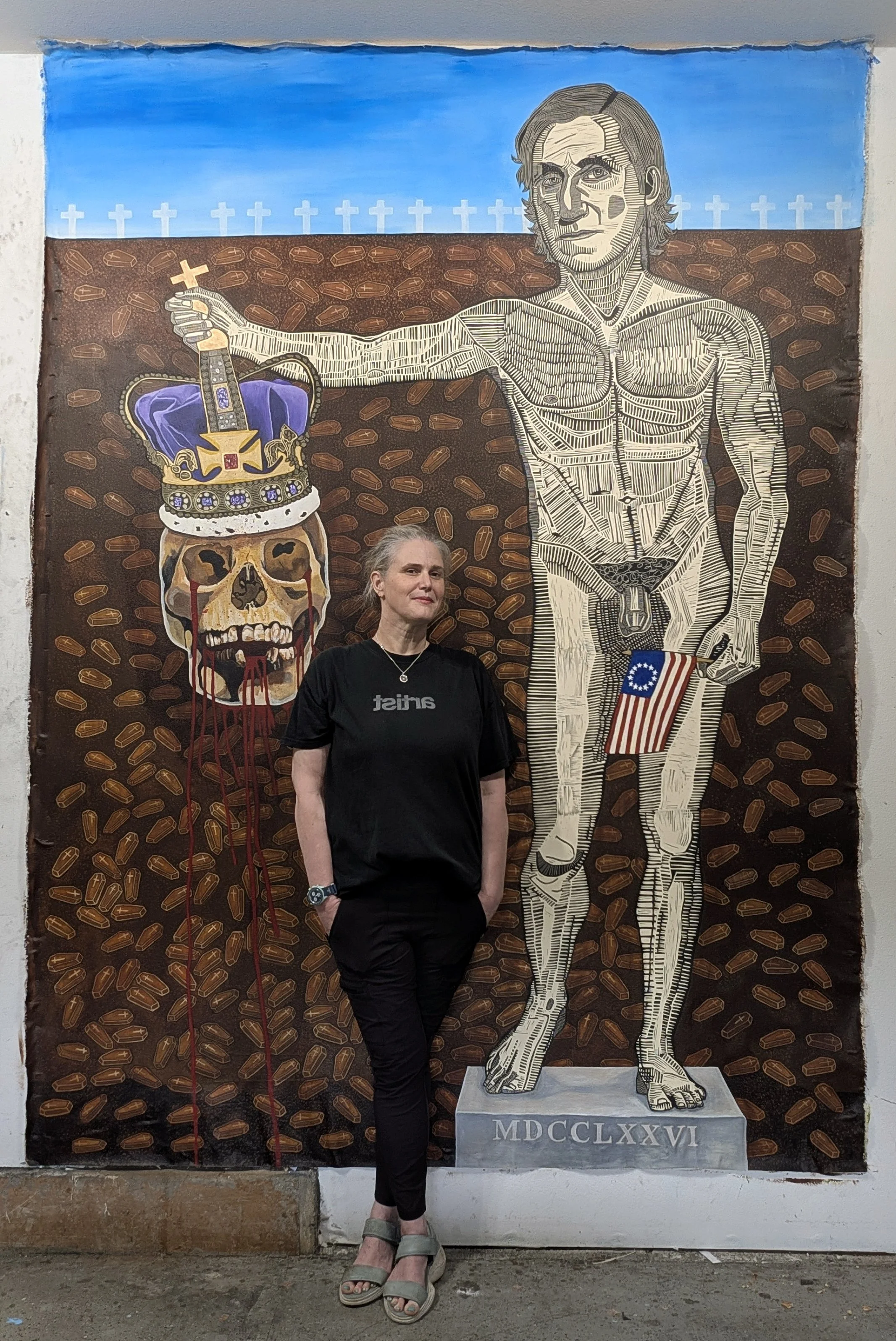
Valerie Wallace’s latest linocut painting about the Revolutionary War. July, 4th 2026